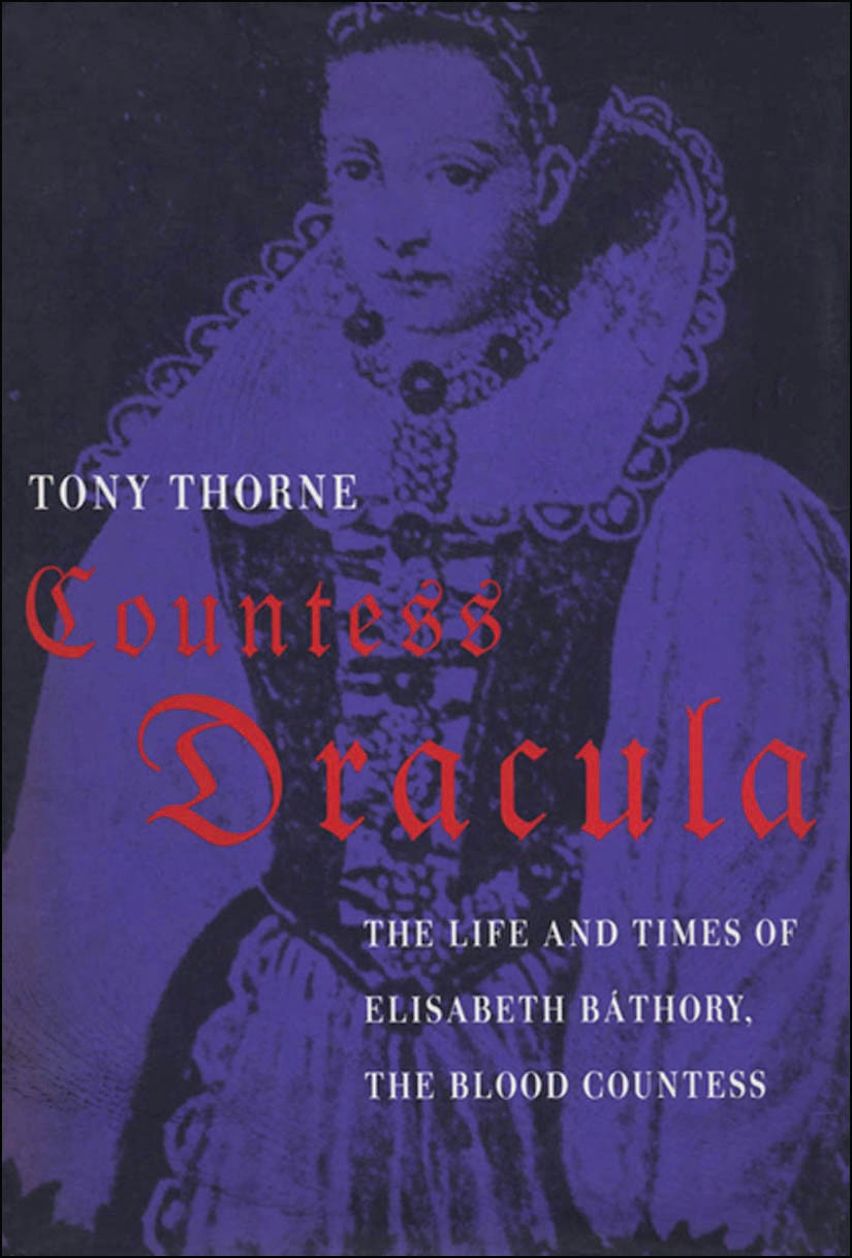
I found an excellent book titled “Countess Dracula – the Life and Times of Elizabeth Bathory” at a local secondhand bookstore recently. After reading the book, it was time to do what I so often do: contact the author for an interview, and spread the good (or evil…?) to my readers as well.
Here’s my interview with Tony Thorne, author and linguist. Thank you, Mr. Thorne, for taking the time to talk to ForenSeek!

Who are you? Tell us a bit about yourself!
I write about language and cultural history and I’m a consultant at King’s College London. I’ve published dictionaries, biographies and many articles, looking particularly at controversial, deviant, outsider language, art and alternative lifestyles.

Would you tell us how you first heard about Elizabeth Bathory and became interested in her story?
In the 1980s and early 90s I explored the newly accessible countries of central and Eastern Europe, regions where seemingly inaccessible languages were spoken and places that had been largely ignored by the West despite their very rich histories, literatures and cultural icons. I began to familiarise myself with the languages and the folklore and looked beyond Vlad the Impaler at other fascinating historical figures. Elizabeth Bathory was a pivotal personality from a dynasty operating in Hungary, Slovakia and Transylvania, but additionally one who had been transformed into a mythical personification of evil.
What she did to young girls was incredibly cruel. Which of her horrible deeds do you find the most shocking?
I was fascinated by the fact that none of the stories of murder and torture by the ‘Blood Countess’ were actually provably true according to modern ideas of evidence. I looked at all the accusations in forensic detail and gave the truest assessment I could without declaring finally for her guilt or innocence. What I think is definitely true is that there was a culture of cruelty and what we now call abuse in those days, in private and in public, inside the great castles and palaces and in the poorest villages too. This realisation and the fact that such things still take place disturbs me.

Do you have any idea why namely girls and young women were the target of her tortures? Is there any evidence that she was cruel towards her own daughters?
Poor females, especially peasants or villagers, were often given over by their families to powerful aristocratic households where they became servants without status, independence or power, at the mercy of the ladies of the court and older members of the household. There is evidence of ill-treatment by other great ladies in other castles and manor houses at the time. There is no evidence at all that Bathory was a bad mother – quite the reverse. I uncovered letters in which she wrote affectionately of her daughters and she was very diligent in overseeing their education, marriages and domestic arrangements.
Can you name any event in Bathory´s childhood or youth that could possibly contribute to the development of her sadistic features?
Despite the colourful legends that have grown up about her, we know almost nothing about Elizabeth’s childhood, only the names of the palaces and castles in which she lived. I could find no evidence of any abnormality or any trauma in her youth, but if there had been, it would have been kept secret and not written about. We do know that her husband was famous for his cruelty in war and his inventive use of tortures in the war against the Turks. Sadly we know, too, that badly behaving children and servants were routinely beaten and tormented in schools and at home at that time.
Are there any grounds to believe that Elizabeth Bathory practiced witchcraft? How was witchcraft performed in Hungary those days?
There is no evidence that Elizabeth herself practised witchcraft in person but there are testimonies showing that she had women practising magic, enchantment and folk medicine in her household. The women of the castles were responsible for healing and many of the medical treatments of the time were indistinguishable from magic.
They say the total amount of her victims reaches nearly 650 girls. Is it a realistic number according to your own estimations?
The figure of 650 seems to have no basis in fact, although it has gone down in history. If we look at the testimonies given during the trial of Elizabeth’s servants (remember that she herself was never put on trial as she was too powerful and influential to put before a court) the servants and the neighbours who reported instances of torture and murder each only mentioned one or two or a handful of victims. It was the noble servants of Bathory’s late husband, living far from Slovakia, who alleged that she was guilty of huge numbers of offences. We can’t take their accounts at face value since their motivation was to discredit her so that she would not be able to prevent her son Paul – who was in their care – to inherit her vast wealth.
Could it be true that Bathory used, as it is recorded, “her teeth” to bite the girls´ flesh? Was it possible that she used her real teeth, or was this rather the name of some instrument of torture?
Some of the medical instruments used by healers at that time (such as the older women in Elizabeth’s court) were identical with instruments of torture, but I found no link between the mentions of ‘teeth’ with these instruments. Whether it was true or not I think the image of biting was meant to emphasise that Bathory became uncontrollable and violent in her supposed confrontations with the helpless girls.

You visited several of Bathory´s castles. Some people say those places are haunted. Did you experience anything strange while standing among the ruins?
As I wrote, I spent considerable time exploring all the places that Bathory had frequented, including the ruins of her castles, her palace at Sarvar and the scene of the final trial, the churches where her priest accusers operated, as well as the villages which the supposed victims had come from. In all these places, particularly at night, I had the strong sensation of crossing into a timeless zone in which past dramas and tragedies resonated with and penetrated into the present.

The Bathory family is famous for its cruelty. Are there any other infamous family members that could be of interest to our followers?
Elizabeth’s nephew Gabor Bathory, the Prince of Transylvania, is another real and glamorous historical figure who became, in his own lifetime, a legendary wild, promiscuous ‘Fairy Prince’, accused in later life of murdering rival nobles before succumbing to insanity, His was finally killed by his own bodyguards.
Elizabeth Bathory spent her final years imprisoned in her home. If you could interrogate her in prison, what questions would you ask her?
I would tell her that she would be remembered as a monster and ask her to defend herself.
The book´s title is Countess Dracula. What is the story behind this title? How would you compare Bathory with the famous vampire count?
I chose this name because it seemed to me that Elizabeth Bathory was the only *female* example of a personification of evil whose reputation rivals that of the real and fictional Count Dracula. The title had already been used for a well-known Hammer horror movie featuring the actress Ingrid Pitt (who helped me with my researches) playing the role of Elizabeth.
Tell us about researching and writing your excellent book!
I feel strongly that in order to research real-life or real lives – or even fictional – events in exotic places, it is vital to move out of the libraries and archives – once you have uncovered all the existing documentation – and carry out ‘field-work’, visiting the locations, questioning the people, looking again at the physical remains.
What are you currently working on?
I’m writing about language and culture, but nowadays on my website (https://language-and-innovation.com/) and online rather than in books, and I’m curating my collection of art and artefacts gathered over forty years of travelling in fascinating places.
Is there anything you’d like to add that I forgot to ask about?
Just that my advice to readers is – enjoy the myths, the legends, the glamorous fictions…………but seek out the facts and search for the truth too.
And, finally, my regular questions.
Your top 3 albums?
Stone Roses, The Stone Roses
Dick Dale, Tribal Thunder
Fairport Convention, Liege and Lief
Your top 3 films?
Shadows of Our Forgotten Ancestors, Sergei Parajanov
Les Yeux sans Visage, Georges Franju
The Maltese Falcon, John Huston
Your top 3 books?
Under the Volcano, Malcolm Lowry
Tao Te Ching, Lao Tzu
The Third Policeman, Flann O’Brien
