Many years ago, I saw an episode of a television show titled “Crime Investigation Australia”. Ever since then, I’ve had a deep, borderline-obsession interest in the Wanda Beach murders and the disappearance of the Beaumont children, two well-known unsolved mysteries from “down under”.
Mr. Alan J. Whiticker is a prolific Australian author who has written books about his country’s history – including its darker side. Among his work are the books “Wanda: the Untold Story of the Wanda Beach Murders” (2003) and “Searching for the Beaumont Children” (2006). In other words: he was the perfect interviewee regarding the two abovementioned topics.
Luckily for me and my readers, Mr. Whiticker was kind enough to take some time off from his writing to answer some questions about the more shadowy corners of a beautiful country.
Thank you, Alan, for your chat with ForenSeek!

Who are you? Tell us a bit about yourself!
I was born in 1958 and have lived in Western Sydney all my life. I was a schoolteacher for 30 years before branching out into freelance writing and becoming a publisher. Married to the lovely Karen for 42 years, we have two adult children together … and one grandson!

You have written several nonfiction books about Australian history. What’s something most people around the world don’t know about the history of your country?
Australia is a constitutional monarchy, which means our monarch (and head of state) lives on the other side of the world in England! Australians are pretty laid back and seem to be ok with this arrangement (a Republican movement failed in the 1990s) but we are proud of being one of the most successful, multicultural democracies in the western world … people come to live here from all around the world and love it!
How did you become interested in “dark history” and true crime? Was it a specific case, or did the interest arise on a more general level?
True crime allows the writer/reader to move outside their comfort zone and experience things beyond their normal lives. In the pre-internet era, I grew up in an era of urban myths and stories of unsolved crimes and wanted to know more, so I started to research and write about these events.
WANDA BEACH MURDERS
In your own, expert’s words: what are the “Wanda Beach murders”?
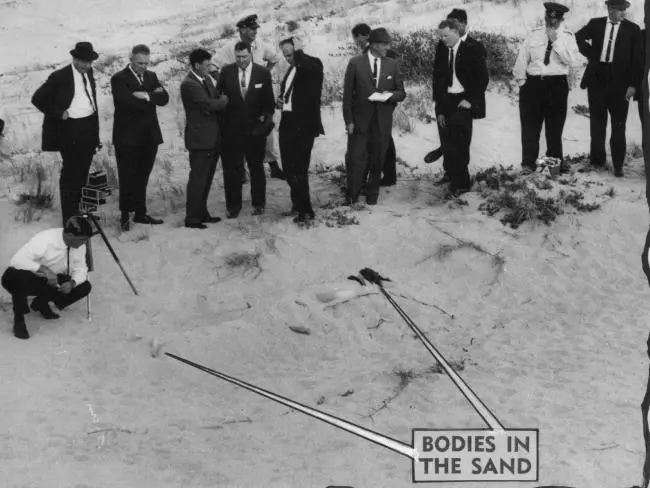
In January 1965, two 15-year-old girls took some younger siblings to a Sydney beach named Wanda. During the day, the girls became separated from the younger kids and were found the next day buried in sand dunes, stabbed to death. The younger children returned home by themselves the previous evening and told police the girls were last seen walking off into the sand hills with a ‘teenage blonde surfie’ type.

How well did the local authorities investigate this case, in your opinion? What did they do right, what did they do wrong?
This terrible crime was completely out of step with the easy going Sixties (I was aged six when this happened) and the local police were overwhelmed by the scope of the case – tens of thousands of people contacted them with theories, dreams and suspects matching the ’16-year-old’ male seen with the girls (this description by the younger children, who were German immigrants with limited English, was essentially flawed). The investigation was swamped and never got the breakthrough it needed in the first 72 hours. Almost 60 years later, the case remains unsolved.
The killings were brutal. Paint us a brief “profile” of the killer! What kind of a person do you think he was?
There was no criminal profiling in 1965 and authorities struggled to get a handle on the killer … it first believed that he was a ‘violent schizophrenic’ with a sexual disorder. The first part of that sentence was perhaps an unfair assumption but the second part was certainly true. The killer tried to rape the girls but could not; he resorted to violence to kill them and then callously buried them in the sand. The original suspect was supposed to be 16 years old but could have been in his twenties.
Do you think the victims knew their killer?
It is believed that the girls may have met the killer on a previous trip to the beach the week before and agreed to meet again. Either way, the killer was able to coax the girls to leave the younger children and walk into the sand hills, so he was very adept at gaining their confidence quickly.
In your opinion, was the attack planned or an “impulsive” crime of an enraged killer?
While the crime itself was opportunistic, the killer knew the local area well and that he wouldn’t be disturbed (the sand hills at Wanda stretched for miles at that time). The crime certainly escalated when the girls resisted, but the killer went there with a knife and blunt instrument so his intention to kill was there from the beginning (i.e. he was looking for a suitable victim).
Do you believe this was a one-off event, or do you think the Wanda Beach case may have been the work of a serial killer?
The crime was so violent there is no way the killer didn’t have previous convictions or just went on to lead a ‘normal life’ … this was one sick individual. Unfortunately, in an era before the internet and computers, there was no ability to look up records or cross reference suspects. The only way to ‘catch the killer’ was to wait for him to commit another similar crime. Unfortunately, that never happened.
You wrote an excellent book on the case. Tell us about the process of researching and writing it!
I was always fascinated by this crime so I pitched it to my publisher (true crime writing was in its infancy and I was mainly a sports writer). I lucked out having previously taught the son of the head detective of unsolved crime in Sydney who granted me access to the original case files. I based my book on what the police knew but also delved into the huge impact of the case in the media and wider society … it took me about six months to write. Some of the criticism at the time was that the book ‘didn’t solve the case’ but I didn’t see that as my main aim – just to tell the victims’ stories as honestly as I could.

Do you have a favorite suspect?
I went into the project with an open mind although the suspect I knew best was a man who was jailed for another murder who trolled detectives with information (and paintings of the crime scene!) that he was involved in the Wanda case. He wasn’t … and the least likely suspect, American serial killer Christopher Wilder, has since come into focus as the person most likely to have committed the murders. The son of an American serviceman, Wilder was already a known sex offender in Sydney in the 1960s and later emigrated to the US, became a millionaire racing car driver and murdered a dozen young women. He was also a photographer who was aged 19 in 1965 and so it is believed he may have coaxed the girls into the sand hills on the pretext of taking their photos. Tragic.
Is there something you’d like to add about the case that I didn’t ask about?
Just to remember that the two victims, Christine Sharrock and Marianne Schmidt, were young girls with hopes and dreams of their own with their whole lives in front of them (they would be 75 years old today). Writing and talking about true crime sometimes devolves into an ‘intellectual’ endeavour in which the victims become objectified. Their deaths affected a lot of people I talked to for my book and the ripples of pain continue on this day, especially for their respective families.
BEAUMONT CHILDREN DISAPPEARANCE
Again, in your expert’s words: what does the term “Beaumont children” refer to?
The disappearance of the three Beaumont Children from a crowded beach in Adelaide (South Australia) on Australia Day – of all days – in January 1966, shocked the nation. The term ‘Beaumont Children’ has become a byword in Australia for lost innocence and also a cautionary tale for young children to go out of sight (‘remember what happened to the Beaumont Children’ parents would say). Mr and Mrs Beaumont were hounded by religious cranks, clairvoyants and the media before being unfairly accused (even by some police) as being responsible for their disappearance.

Where did the police go wrong? Why was this case left unsolved?
Once again, the case was swamped by so much erroneous information and never got the ounce of luck early in the investigation but there was a clear suspect … an unknown man seen playing with the children on the beach and then walking away with them. After writing my second book on the case, ‘The Satin Man’, I detailed a number of mistakes made: the investigation was kept at Glenelg (two detectives, one phone) rather than centralise it in Adelaide with better resources. Police did not want the case to be on their books as a homicide, so kept it as a missing persons case for decades, leading to many myths and misunderstandings over the years. Lastly, when they didn’t get the breakthrough they needed, they took the case down many dead-ends media and turned on the parents.
Do you think this was a planned case, or an impulsive opportunist at work?
Both … people who pray on children are opportunistic but they also groom them and look for the right circumstances to abuse. Like Wanda, the person responsible for the disappearance of the Beaumont Children may have known the children would have been there alone (the children went to the beach alone the previous week), knew the lay of the land (he wore swimming shorts in the colours of a local surf club) and probably lived locally to spirit the children away from the beach and not be seen.
What do you think happened on that day?
The children left Glenelg Beach in the company of a 40-year-old man, six feet tall with light wavy hair brushed back off his face. The man appeared to ‘be with’ the children and gained their confidence very quickly – getting them to wait for him while he went to the dressing rooms to change and then dressing the kids out in the open! The man also complained to some elderly witnesses (there were thousands of people on the beach that day) that ‘someone has stolen our money!’ This was probably a ruse to stop the children from catching the bus home and thus requiring them to go with him.

Do you have a favorite suspect for this case?
In publishing my book ‘Searching for the Beaumont Children’ in 2006, I attempted to put a lot of myths about the crime to rest. I was then contacted by a lot of people with a lot of alternate theories! One family that contact me, told me the story of a wealthy local businessman who lived close to Glenelg Beach and matched the description of the man last seen with the children. They accused him of sexually abusing his son, luring the children from the beach burying them in the sand pit of his factory (this was told to my researcher Stuart Mullins by the man’s son). It appears the man gave the children a one-pound note (about $50 in today’s money) and asked them to buy some lunch and bring him back the change (the children were last seen at a cake shop with the one-pound note). They may have walked back to the man’s house (about 200 metres from the shop and 500 metres from the beach) but completely disappeared. The man, who I did not name, is long dead, as is his son.
A lot of my Australian friends who otherwise have no interest in true crime know this case very well. How significant is the Beaumont children case in the Australian collective memory, in your opinion?
This unsolved case has cast a shadow over the country for six decades now. Every January, on the anniversary of the children’s disappearance, the case is discussed and many meaningless theories are canvassed in the media … the children are alive and well and living in another country; they were sold to a religious cult by their parents, or that they are long dead, buried in some unmarked grave. Any new lead is guaranteed to attract national headlines and there have been numerous cold case documentaries made about the crime.

Your book Searching for the Beaumont Children is a fantastic examination of this incident. Tell us about researching and writing that one!
After my book on Wanda was released, another publisher contacted me and asked me if I could write a similar book on the Beaumonts. Originally, I said no … there was not suspect, no (living) witnesses, no crime scene and no suspect! Also, SAPOL were notoriously strict on sharing details of the case with the media … but I changed my mind when the publisher said I should do a social and cultural study on how the case changed Australia. I was in!

Is there something you’d like to add about this case that I didn’t ask about?
Just that multiple abductions of children from a public place is incredibly rare around the world, let alone sleepy Adelaide … this is one of the main reasons the case wasn’t solved. Also, former detectives told me that the worst possible suspect in these types of cases is the ‘unknown offender’ and this was certainly the case with the man who took the children (whoever he was). He was hiding in plain sight! Lastly, there is a thematic link between Wanda and the Beaumonts that was investigated at the time
Do you think either of these cases will ever be solved?
Wanda may never be solved because NSW police misplaced the sperm sample but there is some faint DNA on some of the crime scene exhibits. There is an excellent book by Andrew Byrne called The Beauty Queen Killer (2018) that lays out the case that serial killer Christopher Wilder was responsible for the crime (I named him as one of three main suspects in 2003 but Wilder has increasingly come into view in recent years.) The Beaumont Children case will only ever be solved when they find the children’s bodies. We have good information that the remains on the three children are buried on a now vacant factory site but there is not political will (or money!) to finance a major dig. South Australian Police (SAPOL) have actually told us that there is no money to solve crimes from 5 years ago let alone 58 years ago! Time has worked against us … all the witnesses, serving police, original journalists and family members are now dead.
What are you working on at the moment?
I do a lot of work on sporting titles, namely horse racing and rugby league (13-man rugby) which are both very big here in Australia. I am also working on a novel (a ‘whodunnit’ set in the 1980s) and researching a history of Oscar-winning movies. I’ve also written on pop culture and music history so am always looking for new projects.
Where can people keep up with your work?
I’m hoping to launch a website soon but most of my books are featured on websites such as Amazon, Booktopia, New Holland Australia or Rockpool Publishing. And you can always pick up an old copy on eBay!
And, finally, my regular questions to all my interviewees (as an author on books about films and music, you might find these fun to answer!
Your top 3 movies?
STALAG 17 (1953): Acerbic Billy Wilder prisoner of war film where William Holden, in his Oscar-winning role, is accused by his fellow prisoners of being an informer … a brilliant film about scapegoating with more than a dash of dark humour.
COOL HAND LUKE (1967): Sixties masterpiece with arguably Paul Newman’s best performance as a non-conformist who refuses to buckle under society’s rules and regulation. Great score by Lalo Schifrin and an Oscar-winning turn from George Kennedy.
THE GODFATHER PART 2 (1974): Superior sequel/prequel to The Godfather (1972) with a great performance from Al Pacino and Robert De Niro as the young Vito Corlone. Cautionary tale about how power corrupts even the strongest of family units.
Your top 3 albums?
THE BEATLES (White Album) (1968): Thirty tracks, such great diversity; The Beatles at their best!
SCHOOL’S OUT / Alice Cooper (1972): The highpoint of the original Alice Cooper band. Remember the Coop!
GOODBYE YELLOW BRICK ROAD / Elton John (1973): Elton John’s ‘White Album’ … not a wasted track on four sides of classic pop rock vinyl.
Your top 3 books?
LORD OF THE FLIES / William Golding (1954): Read this in high school at an all-boys Christian Brothers college. Mind-blowing.
TO KILL A MOCKINBIRD / Harper Lee (1960): Set in the 1930s, this book illuminated the Sixties Civil Rights movement for me. Also made a great film!
ALL THE PRESIDENT’S MEN / Bob Woodward & Carl Bernstein (1974): A forensic unmasking of the Nixon presidency which resulted in his resignation in 1974.
* Special mention to Homer’s THE ILLIAD which I read when I was 9 which began a lifelong love of Greek mythology and the Trojan War.
