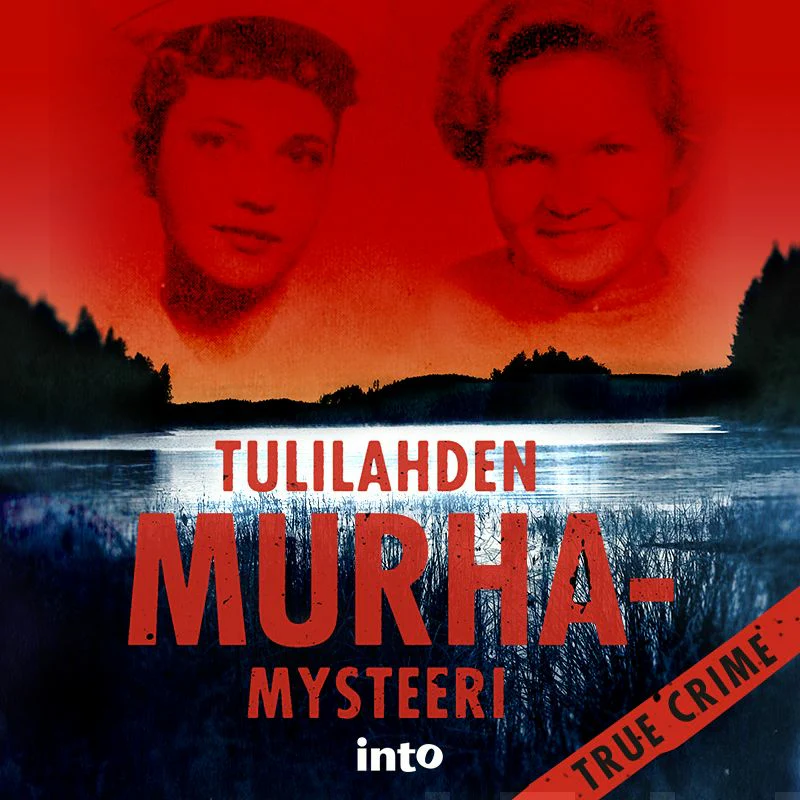
The Tulilahti double murder is a “classic” in the annals of Nordic unsolved mysteries.
Recently, a new book came out about this morbid but fascinating case, titled “Tulilahden murhamysteeri” (Finnish for “The Tulilahti Murder Mystery”). If you want to see the book translated into your language, email your favorite publisher with a request!
Below is my interview with the author of the book, Mr. Mikko Pennanen.
Thank you, Mikko, for taking the time to talk with ForenSeek!

Who are you? Tell us a bit about yourself!
I’m Mikko Pennanen and I’m currently a non-fiction writer. I live in Joensuu and have lived in North Karelia for most of my life. I have a Master’s Degree in philosophy and a degree in archiving. I studied history at university and graduated as a historian.
During my life I have worked in a variety of jobs, including archivist, schools, and the service and industrial sectors. I plan to continue writing true crime non-fiction books in the future.

How did you become interested in the Tulilahti case?
I have been interested in true crime cases since I was a teenager in the 1980s.
The first time I became acquainted with the Tulilahti murders was, I think, in 1997, when the documentary series “Ei vanhene koskaan” (a classic Finnish true crime TV show. -admin) was shown on TV. One of the episodes was about the Tulilahti murders. The case immediately struck me as interesting, and there was something special about the setting. Two hikers were killed in an idyllic countryside setting, and the perpetrator (or perpetrators) was/were ever caught.
The case also raised the question of whether Runar Holmström, who was arrested for the murders, was actually responsible. This question has stayed with me.
In your own words: what is the “Tulilahti double murder”?
The Tulilahti case is more commonly referred to as the “Tulilahti double murder”, because there were two victims and the perpetrator(s) would probably have been convicted in court for two murders.
The Tulilahti double murder is one of the most famous unsolved homicides in Finland and is often counted among the three most famous cases. The others are Kyllikki Saari´s 1953 murder in Isojoki and the 1960 triple murder at Lake Bodom, Espoo.The Tulilahti double murder took place in Heinävesi at midnight or early morning on 28 July 1959. The two women, Eine Nyyssönen and Riitta Pakkanen, had camped the previous evening in an unguarded camping area on the shore of Lake Kermajärvi. The murders were only discovered three and a half weeks later, as the perpetrator(s) hid the bodies more than 200 meters from the campsite.

How were the victims killed?
Both victims had been struck in the upper body with a bladed weapon, and Riitta Pakkanen had also very probably been hit in the head with a heavy object. She had died from fractures to the head, but the murderer had ensured her death with several blows from a bladed weapon. According to the autopsy report, it was not clear which weapon had been used first, but striking first with a knife seems more logical.
Eine Nyyssönen had also been strangled. She died of a wound from a bladed weapon that penetrated as far as the lung.
Neither of the two victims had any injuries or wounds on their hands from defending themselves, so it is possible that they were surprised from sleeping in the tent or that they did not know to be alert to the threat.
Eine Nyyssönen probably escaped the killer for a short time. She was stripped naked, but neither woman was apparently raped. The attempt at raping the victims seemingly did not succeed, or perhaps the perpetrator received sexual satisfaction from the violence itself. Sexual murders often do not involve the actual act of rape.
What kind of a historical context does the crime have in Finland? Had similar crimes been committed before?
The double murder in Tulilahti was an exceptional crime in the sense that similar tent murders had never been committed in Finland before. The killing of two women at the same time was also very unusual. In cases like this, there was usually only one female victim.
The double murder in Tulilahti was followed less than a year later by a similar case in Bodom, where three young people were killed with a knife and another unknown, heavy object, as in Tulilahti. One of the youths survived.
Tent camping only became popular in Finland in the 1950’s, and reached its peak in the 1970’s and 1980’s. Many campsites were guarded.
In 1972, three campers were killed in Hyvinkää, on the shore of the lake Kytäjärvi. They had not camped at an official campsite, and were the only people at the lakeside at the time. However, the perpetrator was caught almost immediately.
The double murder at Tulilahti was an exceptional case also in the sense that there were relatively few homicides in Finland in the late 1950’s. It would be interesting to know how common harassment and bullying of campers was at that time. I myself have heard of some cases where at least tent cords were cut.
In your opinion, how well did the Finnish police handle the investigation?
The investigation was unsuccessful because the crime was not solved. However, it must be kept in mind that the police certainly did everything they could to solve the crime with the information and resources they had at their disposal at the time.
In the Tulilahti case, the police were already criticized during the investigation. The police themselves admitted that mistakes were made during the investigation.
The crime scene investigation was nowhere near the current standard. In the early stages, the investigation was diverted because of false eyewitness accounts, and it seems that the focus was too much on looking for the culprit among the moped riders, tramps and criminals, and the people who were just walking on the side of the roads near the location of the crime. In my opinion, too much weight was given to eyewitness observations – these observations are very uncertain from an investigative point of view. In the case of Tulilahti, the observations fed off each other and, for example, suspected moped riders were suddenly seen everywhere!

The main suspect in the murders was a man named Runar Holmström. How was he “selected”?
Police were looking for an unidentified moped rider, whom they suspected of being the murderer, based on eyewitness accounts. The moped man was suspected of following Eine Nyyssönen and Riitta Pakkanen for some time. Runar Holmström was considered to fit the description of the moped driver.
Runar was linked to the double murder in Tulilahti through the words of his brother Arne Holmström. Arne was known, however, for sometimes telling tall tales. Arne had said, for example, that “the Heinävesi thing might have been Runar’s doing”, and that he had seen Runar riding around that summer in Eastern Finland. According to Arne, Runar was driving a blue moped at the time. Arne’s words reached the ears of Police Inspector Axel Skogman, who began to suspect Runar of the Tulilahti murders.
The background and the initial impetus for the suspicion towards Runar was therefore the talk of Runar’s brother.
Inspector Skogman had himself been involved in the Tulilahti investigation before Runar was “selected”, and had visited Heinävesi to investigate the claims that the murderer was the same person as in the Kyllikki Saari case.

What are your thoughts on Runar’s guilt?
The question of Runar’s guilt was one of the fundamental reasons why I started to investigate the Tulilahti double murder. To me, the guilt seemed unclear from the beginning and the evidence against Runar seemed vague. In my opinion, the theory of Runar’s guilt was not credible, but seemed to be pursued like it was a given.
There is no incontrovertible evidence that Runar was moving around Heinävesi at the time of, or after, the murders. There is no definite proof of this and the lack of indisputable evidence speaks for Runar’s innocence. It seems strange that the main suspect in the murders was “found” hundreds of kilometers away from the crime scene, in Swedish-speaking Ostrobotnia, even though there was evidence of more potential suspects located near the crime scene the night before the murders, and they were among those arrested by the police in earlier stages of investigation into the double murder.
The culprit would probably have been found among the local population, as the perpetrator had knowledge of the local geography, and the killer had clearly re-visited the area around the lake to “improve” the hiding spots for the victims’ items after the murders. For example, according to one witness, two men arrived at the campsite by boat the night after the murders – clearly still working on those hiding spots.
Perhaps too much weight was given to Runar’s criminal record. It should be remembered, however, that he was a property criminal, and had no record of violence or sexual offences.
Often the culprit is the person with whom the victim(s) have been proven to have spent the last hours of their lives.
Did the police have other prominent suspects?
In the initial phase of the investigation, the search for the perpetrator was directed specifically at local men. Police arrested five men living near the crime scene, among them two young men who had visited the murdered women at the campsite, but all of them were released after a few days.
The men who had visited the campsite were arrested on two occasions, as was a man who lived near the campsite and was found with blood on his clothes, wounds on his hands and a knife missing, among other items.
The men who visited the campsite were interested in Eine Nyyssönen and Riitta Pakkanen. According to interrogation reports, at least one of the men harassed and interfered with the physical integrity of one of the two women.
Apparently, the arrested locals had an alibi from someone, or the police considered their accounts of the night otherwise reliable.
What do you think about the theory that the culprit at both Tulilahti and Lake Bodom was the same killer?
I have never considered them as crimes committed by the same person, because the perpetrator of the Tulilahti murders had local knowledge and was probably from Heinävesi. At Lake Bodom, the perpetrator also likely came from somewhere nearby. The vast geographical distance between these two crimes also contributes to the argument for a different perpetrator.
Do you think the Tulilahti double murder can still be solved somehow, or is it too late by now?
I don’t think the case can be solved anymore. It has been too long since the Tulilahti murders and the perpetrator is certainly dead. The police have no longer actively investigated the case.
As far as is publicly known, there is no longer any material available on the Tulilahti double murder that would allow for modern and still developing investigation methods to be applied on it.
I do hope that something will still be found, for example the women’s missing property, or that someone will come forward with the truth. However, I do not think that will happen. If someone were to tell us something interesting, it would have to be proven true, or an object found somewhere would have to be proven to have belonged to Eine Nyyssönen or Riitta Pakkanen.

Tell us a bit about researching and writing your book!
I have been collecting source material since the early 2000’s, and the internet was also a good help in gathering information. However, the most secure and comprehensive information was in the archives.
The idea of writing a book took a long time to mature in my mind. The Tulilahti murders had not been the subject of an entire individual book that would deal with the case in more detail. I went through the Tulilahti trial documents towards the end of 2010, then finalized the outline of the manuscript and started writing.The writing process took some time, as the book is deliberately rich in detail and the sources always have to be checked. All in all, the writing process is very rewarding, because the result of the work is immediately visible.
I am quite satisfied with the final result, because the Tulilahti double murder is a very challenging subject. Writing about an unsolved homicide requires a lot of thought. You have to look at the case from different angles – including the perspective of the perpetrator.
Do you think an English translation of your book will materialize some day?
I am not aware of any upcoming English translation of my book, but it would be great! Hopefully, the subject matter would also attract interest abroad.
What’s your next book project?
My next book is currently in the works. What I can reveal about the book project is that it is also about Finnish murder cases.
Is there anything you’d like to add that I forgot to ask about?
I’d actually like to tell you a bit about true crime writing in general. For me, the writing process is kind of like a peek into the human mind. It raises the question “why did a crime happen?” But not everything can always be explained. The crime cases are sometimes very touching and difficult, but the cases I have written about have not, at least so far, come haunting my dreams. During the writing process, you have to remember to take good care of yourself. It is important to get enough rest and also exercise. Personally, I have found it good to take my mind off things altogether from time to time. I regularly do completely different things as a counterbalance to my writing – nature, for example, means a lot to me.
And finally, my regular questions to all my guests.
Your top 3 records?
Led Zeppelin – “IV”
Black Sabbath – “Paranoid”
Metallica – “Master of Puppets”
Your top 3 movies?
“The Shawshank Redemption” (1994)
“Fargo” (1996)
“Forrest Gump” (1994)
Your top 3 books?
Arto Paasilinna – “Jäniksen vuosi” (translated into English as “The Year of the Hare” -admin.)
Heikki Turunen – “Maan veri”
Väinö Linna – “Täällä pohjantähden alla” I-III (translated into English as “Under the North Star” -admin.)
